How thick should a concrete driveway be?
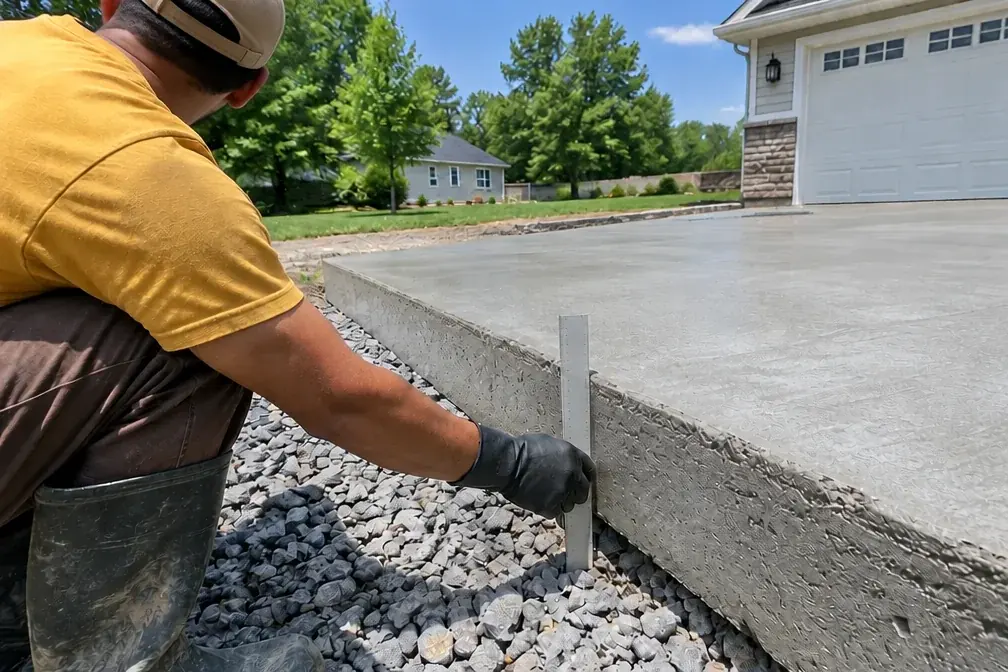
Concrete driveway thickness should be at least 4 inches, and in Pittsburgh we usually recommend 5. Going from 4 to 5 inches adds about 25 percent more concrete, yet it makes the slab much stronger. Here's how to work out what yours needs, and what goes under it.
Updated
| Use | Slab | Stone base | Steel |
|---|---|---|---|
| Walkway beside a driveway | 4 inches | 4 inches | Optional |
| Cars and small SUVs | 4 to 5 inches | 4 to 6 inches | Mesh or rebar on poor soil |
| Pickups, vans, boat trailers | 5 to 6 inches | 6 inches | Rebar grid |
| Apron at the street | 6 inches | 6 inches | Rebar grid |
| RVs and delivery trucks | 6 inches or more | 6 to 8 inches | Rebar grid |
Why thickness matters so much
A slab's strength grows much faster than its thickness. The reason is that bending strength depends on the square of the depth. A 5-inch slab can take roughly 50 percent more bending load than a 4-inch slab, and a 6-inch slab about twice as much, on the same base. So a single extra inch costs you very little compared with what it adds.
An extra inch of concrete adds about 25 percent to the concrete bill on a 4-inch slab, and only a small amount to labor. On a typical driveway, it may add $0.50 to $1 per square foot. That's why we start at 5 inches for most Pittsburgh jobs. It gives some margin for soft spots, and for the delivery trucks and contractors' vans that find their way up your driveway sooner or later.
Do concrete driveways need gravel?
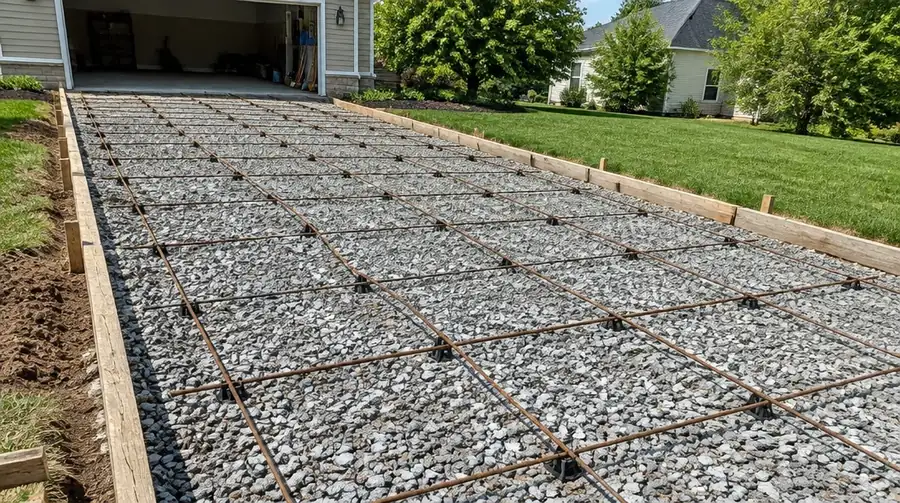
A slab doesn't float on stone so much as rest on it evenly. The stone gives a flat, firm surface and a way for water to drain from underneath, and it keeps clay soil from pumping up through the joints. For a Pittsburgh driveway, expect 4 to 6 inches of compacted crushed stone, typically PennDOT 2A, on firm subgrade.
Compaction matters more than depth. Loose stone will settle, and the slab will settle with it. It should be placed in layers and run over with a plate compactor or roller. Anything soft or organic has to come out first. Old driveways in the city are sometimes sitting on old cinders, ash or fill, and that needs to be dug out instead of being covered up.
Rebar, mesh or fibers?
Steel doesn't stop concrete from cracking. It holds cracks tight once they form, so that the two sides stay level. Here's how the options compare.
| Option | What it does | Our view |
|---|---|---|
| #4 rebar grid | Holds cracks tight and adds stiffness | Best on hills, poor soil and heavy loads |
| Welded wire mesh | Holds cracks tight at lower cost | Fine if it stays in the middle of the slab |
| Synthetic fibers | Reduce early shrinkage cracks | A good addition, but no substitute for steel |
Getting the steel in the right place
Steel lying on the stone does almost nothing. It has to sit in the middle or upper part of the slab, so it needs to be on chairs or blocks rather than being pulled up with a hook as the concrete goes in. Keep it at least 2 inches from the edges and any joint, so that water can't reach it and start rust. On a good base with short panels, a plain slab can do fine, but in our soil the extra steel is cheap insurance.
Edges, joints and slope
Thickness isn't the only number on a quote that deserves attention. These details keep the slab from cracking where you don't want it to.
- Thicken the outside edges by an inch or two, where wheels run near the unsupported side
- Space joints no more than about 10 to 12 feet apart on a 5-inch slab
- Cut joints to a quarter of the slab depth
- Keep panels close to square, with no long, narrow strips
- Pitch the slab about 1/4 inch per foot so that water runs off
- Use isolation joints at the garage, curb, steps and walls
Thickness on Pittsburgh soils and slopes
Most of the Pittsburgh area sits on clay and shale, often with old fill on top. Clay soaks up water, swells and softens, then shrinks in dry spells. On that kind of ground, a thin slab can lose support in spots and crack under a car. Extra stone and an extra inch of concrete give it more margin. Where the subgrade stays wet, we may also add a layer of geotextile fabric, which keeps the clay from working up into the stone.
Slopes add load of their own. A car braking on a hill pushes the slab downhill, and water tends to run under the edges. That's why steep driveways get steel in nearly all cases, along with a thickened edge at the street. Service trucks are worth planning for too. An oil delivery truck or a loaded dumpster can weigh ten times what a car does, and it only takes one trip to crack a thin slab.
Working out how much concrete you need
Multiply length by width by thickness in feet, then divide by 27 for cubic yards. A 12 by 40 foot driveway at 5 inches is 480 square feet times 0.417 feet, or 200 cubic feet, which comes to 7.4 yards. Order about 5 percent extra for waste, so that's about 8 yards. One yard covers about 81 square feet at 4 inches, or 65 square feet at 5 inches.
Our driveway estimator will do the math for you and draw the joints. If you want to know what happens after the pour, read how long before you can drive on new concrete.
Common questions
How thick should a concrete slab be for a driveway?
At least 4 inches, and 5 is better in Pittsburgh. Go to 6 for heavy trucks.
Can you pour a concrete driveway without rebar?
Yes, on a firm base with good joints. Steel is still worth it on hills and clay.
Do you need rebar in a driveway?
It isn't always required, but it helps hold cracks tight, and it's cheap for what it does.
Does a concrete driveway need rebar?
Codes rarely demand it for homes, but we use it on most Pittsburgh slabs because the soil moves.
Should a concrete driveway have rebar?
On hills, clay or anywhere heavy trucks go, yes. On a short, flat, firm site, it's optional.
What depth of concrete for driveway?
5 inches suits most homes here, and 6 inches is better at the apron or for heavy vehicles.
Does concrete slab need rebar?
Not always. Short slabs on firm ground do fine, but larger or loaded slabs benefit.
Does fiberglass concrete need rebar?
Fibers control early shrinkage, but they don't replace steel in a loaded slab.
Can you pour a concrete driveway over gravel?
Yes, and that's the usual method, as long as the gravel is compacted.
Can you use pea gravel under concrete?
It isn't a good choice. Round stone doesn't lock together. Crushed stone is much better.
How to calculate yards of concrete for a driveway?
Multiply length, width and thickness in feet, divide by 27, then add 5 percent.
How much does a yard of concrete cover at 4 in thick?
About 81 square feet. At 5 inches, it covers about 65 square feet.
More driveway services
- concrete driveway installation
- concrete driveway replacement
- concrete driveway repair
- concrete driveway resurfacing
- stamped concrete driveway
- exposed aggregate concrete driveway
- driveway trench drain
- driveway drainage
- driveway apron
- concrete driveway sealing
- driveway crack repair
- sunken driveway repair
- driveway extension