What does a heated driveway cost?
Heated driveway cost usually runs $14 to $25 per square foot for electric systems, on top of the price of the concrete. It sounds like a luxury, but on a steep Pittsburgh hill that nobody can climb in January, heated tire tracks can be a practical choice.
Updated
| System | Added cost | Running cost | Best for |
|---|---|---|---|
| Electric mats or cable | $14 to $25 per sq ft | Higher per hour | Most homes, tire tracks |
| Hydronic tubing | $18 to $30 per sq ft | Lower with a good boiler | Large areas, big homes |
How heated driveways work
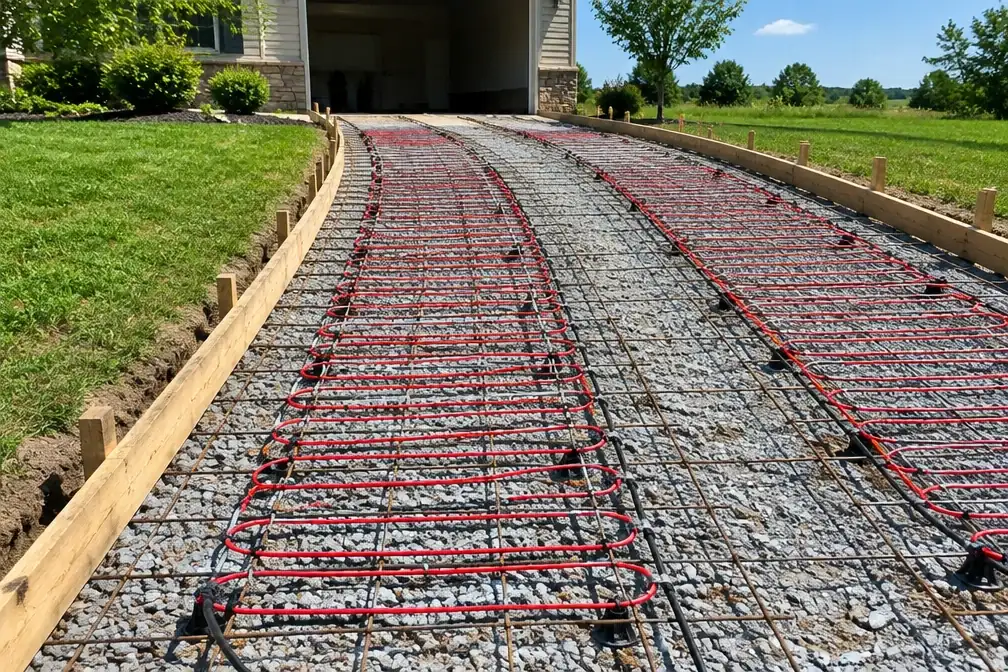
A heated driveway is sometimes sold as a driveway warmer, but there are two main systems. Electric systems use mats or cables set in the slab, which warm up like a giant electric blanket. Hydronic systems run a heated glycol mix through tubes in the slab, from a boiler in the garage or the house. Both need a sensor that detects moisture and low temperatures, so that the system only runs when snow is falling or about to.
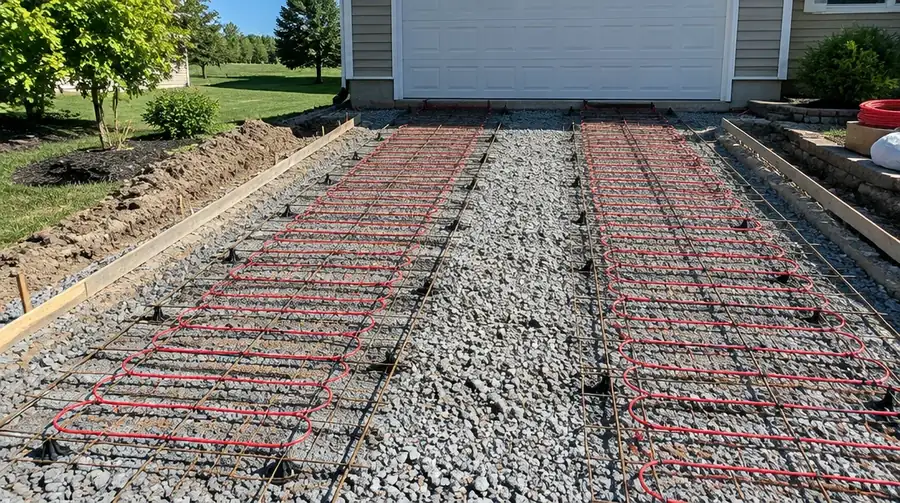
Either way, the heating is a separate trade from the concrete. A qualified electrician or a heating contractor designs and connects the system, while the concrete crew builds the slab around it. If you're interested, tell your concrete contractor before any work starts, since mats have to be in place before the pour and can't be added to an existing slab without cutting it.
What it costs to install
Heated driveway installation cost depends on how much of the slab you're heating. Heating all of a 500 square foot driveway could add about $7,000 to $12,500 to the job. Heating just the tire tracks may cover a third of that area for a third of the money, and on a straight driveway, it does most of the useful work.
Electric work is a big part of the price. A system this size draws a lot of power, often 30 to 50 watts per square foot, so it needs its own circuits and may call for a panel upgrade. Check that before anything else. Older houses in Pittsburgh with small electrical services can face a real added cost before a single mat is laid. Hydronic systems need a boiler and a mechanical space, and they cost more up front.
What it costs to run
Running costs depend on how many hours of snow you get and on your rate. As a rough example, 500 square feet at 40 watts per square foot draws 20 kilowatts. At around 15 cents per kilowatt-hour, that's $3 an hour. A storm that takes five hours to melt costs about $15. A typical Pittsburgh winter might come to a few hundred dollars for a whole driveway, and less for tracks.
Hydronic systems usually cost less per hour to run, especially on natural gas, but they take longer to warm up. Either way, an automatic sensor pays for itself, since a system left on by hand runs far longer than it has to. It's best to think of the running cost as a line in your winter budget that replaces some of the plowing bills.
Is a heated driveway worth it?
For most flat lots, it's hard to justify. A shovel and a plow are far cheaper. It can make sense in cases like these.
- A steep driveway that becomes impassable in ice
- Someone at home has trouble clearing snow, or a fall would be serious
- You need to get out for work, whatever the weather
- A driveway that drops toward a garage, where ice builds up
- You are already replacing the slab, so the added cost is lower
- You pay a lot for plowing every winter
Electric or hydronic?
For most Pittsburgh homes, electric makes more sense. It costs less to install, it needs no boiler and it reacts quickly once snow starts. There's also less to maintain, as no pumps, valves or fluid are involved. The trade-off is the higher hourly running cost, and the load on your electrical panel.
Hydronic systems pay off on larger areas, or where a house already has a suitable high-efficiency boiler or plans to add one. They're more work up front, with tubing, a manifold, a pump and a mechanical space, and the fluid has to be checked every so often. Over many winters, the lower running cost can bring the total closer to electric, particularly if you heat the whole slab and not just the tire tracks.
Either way, the system should be sized for how fast you need the snow gone. A design that only just keeps up may leave a wet slab that refreezes at the edges, so ask your installer what happens during a long, cold storm and where the meltwater goes once it runs off the heated section.
Questions to ask before you buy
A heated driveway is a long-term system buried in a slab, so it's worth getting clear answers before anyone pours. These are the questions we'd ask.
- Who designs the layout, and who tests it before and after the pour?
- How much power does it need, and does my panel have room?
- What sensor runs it, and where does that sensor go?
- Where will the meltwater drain, and will it refreeze?
- What warranty covers the mats or tubing, and for how long?
- What happens if a cable fails after the slab is poured?
What it does for the concrete
Heat has a real side benefit. With no ice, you don't need deicing salts, and that takes away one of the main things that damage concrete. You also avoid plow damage. But heated slabs need care too. Mats should sit at the right depth, with steady spacing, and cables shouldn't run through saw cuts. Joint layout should be worked out with the heating contractor, and crews have to avoid damaging mats during the pour. A test before and after the pour is a must, and any good installer will insist on one.
You can also consider cheaper options. Good drainage, a textured finish and sand can go a long way on a moderate slope. An exposed aggregate driveway offers strong grip, and a trench drain keeps meltwater from freezing at the bottom of a hill.
Planning it with a new driveway
Heat only really makes sense as part of a new pour, so bring it up when you first talk to your contractor. We'll need the mat layout before setting the joints, and we'll want your electrician or heating contractor on site before the pour. The slab itself costs what it normally would, and our concrete driveway cost guide has those numbers. If you're thinking of heating a driveway, ask us about it at your site visit and we'll tell you how the concrete side would work on your lot.
Common questions
Are heated driveways worth it?
On a steep or safety-critical driveway, they can be. On a flat lot, usually not.
More driveway services
- concrete driveway installation
- concrete driveway replacement
- concrete driveway repair
- concrete driveway resurfacing
- stamped concrete driveway
- exposed aggregate concrete driveway
- driveway trench drain
- driveway drainage
- driveway apron
- concrete driveway sealing
- driveway crack repair
- sunken driveway repair
- driveway extension