Best concrete driveway sealer for Pittsburgh winters
The best concrete driveway sealer for most Pittsburgh homes is a clear penetrating silane or siloxane, not a shiny coating. It soaks into the top of the slab and keeps out the salt brine and water that cause scaling, without making a sloped driveway slick. Stamped and colored driveways are the exception, and here's how to choose for yours.
Updated
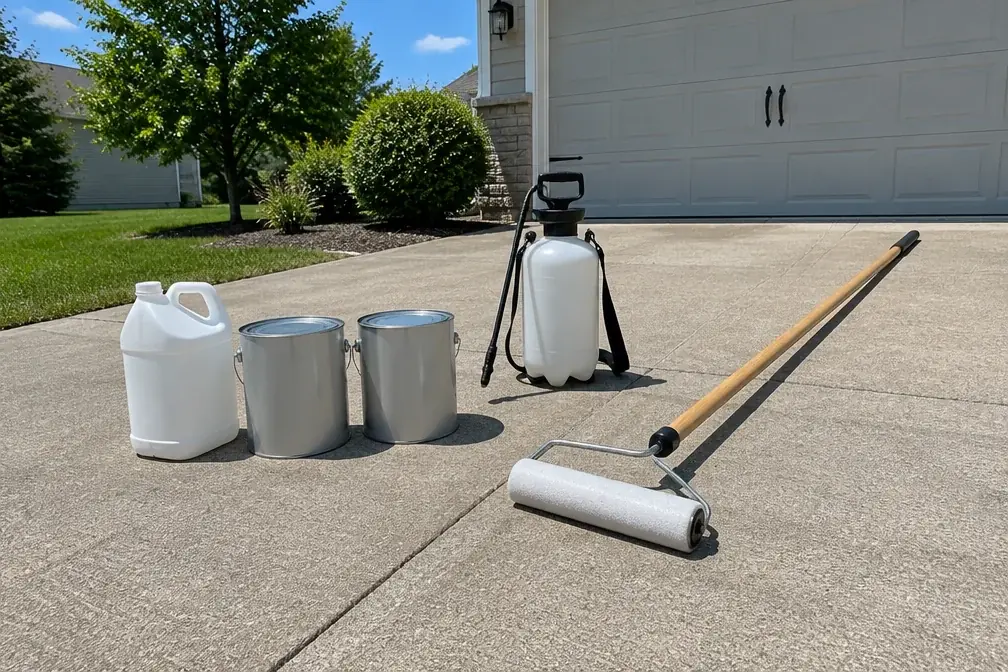
| Sealer type | How it works | Lasts about | Best for |
|---|---|---|---|
| Silane | Soaks in deep and repels water | 3 to 5 years | Plain driveways, heavy salt |
| Siloxane, or a silane-siloxane blend | Soaks in and repels water, a little shallower | 3 to 5 years | Most broom-finish driveways |
| Acrylic, water-based | A thin film on top | 2 to 3 years | A light sheen on stamped or colored slabs |
| Acrylic, solvent-based | A tougher film with a wet look | 2 to 3 years | Stamped driveways |
| Silicate densifier | Hardens the surface, does not repel water | Varies | Not a sealer on its own outdoors |
| Epoxy or urethane | A thick coating | Peels outdoors | Garage floors, not driveways |
What a sealer has to do here
A driveway in Pittsburgh faces water, frost, road salt and, on a lot of lots, a steep slope. The best concrete driveway sealer for those conditions keeps liquid water and brine out of the top of the slab, lets water vapor escape from below, survives tires and plows, and doesn't turn the surface into a slide when it's wet.
Film-forming sealers, such as acrylics, sit on top of the concrete. They give a sheen or a wet look, but tires wear them, salt and sun break them down, and water trapped under them can turn them white and cloudy. Penetrating sealers soak in and react inside the pores. You can't see them, and there's nothing on top to wear off, which is why they suit a plain driveway so well.
Silane, siloxane or a blend?
Silane molecules are very small, so they soak in deepest. That makes silane a strong choice on dense, well-finished concrete and on driveways that get a lot of salt. Siloxane molecules are larger. They don't go as deep, but they work well on more open, porous concrete and on older driveways. Many of the best products blend the two, so you get the depth of one and the coverage of the other.
What you'll want to look at on the label is the active content, which is often given as a percent of solids or silane. A cheap sealer can be mostly carrier with very little of the part that actually does the work. Higher content usually means longer protection. Also check the label says it's made for exterior concrete that sees deicers, and whether it's safe for your finish if the driveway is colored or stamped.
When acrylic is the better choice
Stamped and colored driveways are where acrylic earns its place. The film deepens the color and helps protect the color hardener and release powder at the surface. A solvent-based acrylic gives the richest wet look, and a water-based acrylic gives a softer sheen. Either way, it needs redoing every two to three years in our climate, and more often in the wheel tracks.
The catch is grip. A glossy film on a sloped driveway can be dangerous in rain or light frost. Ask for a non-slip additive mixed into the final coat, and keep the coats thin. Thick acrylic also traps moisture, and that's when it turns milky. See stamped concrete driveway for how we look after patterned slabs.
Testing whether your driveway needs sealing
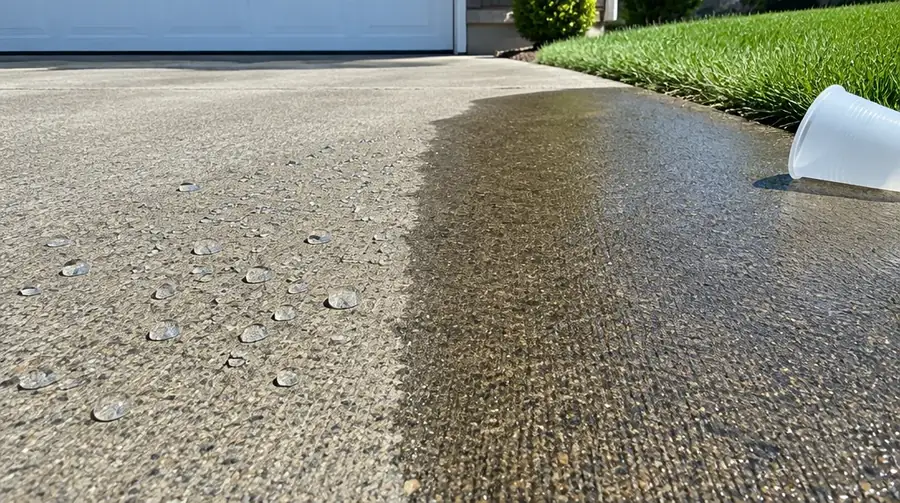
You don't need a lab. Splash a cup of water on a few spots, including the wheel tracks and the area in front of the garage. If it beads up and sits there, the sealer is still working. If it darkens the concrete and soaks in within a minute or so, the surface is open and ready for sealer.
Do the test after a dry spell, since damp concrete will always look like it's soaking water in. And test any old sealer before you buy a new one. A penetrating sealer can't soak in through an old acrylic film, so a worn film has to be stripped or worn away first.
How to apply it so it lasts
Most sealers fail because of how they went on, not the product itself. These are the steps we follow, and they apply just as much if you're doing it yourself.
- Wait about 28 days after a new pour, longer in cool weather
- Fill cracks and joints first, so you are not sealing over open gaps
- Clean off oil, dirt and old loose sealer, then let the slab dry for at least a day
- Pick a dry day above 50°F with no rain due for 24 hours
- Apply with a low-pressure sprayer or roller, at the coverage on the label
- Brush out puddles, as pooled sealer can leave dark or slick spots
- Keep cars off for as long as the label says, usually a day
Doing it yourself or hiring it out
Sealing a sound driveway is a fair do-it-yourself job if you have a free weekend and dry weather. The work is mostly in the cleaning and the waiting. Where it pays to have someone else do it is when cracks or joints need repair first, the old sealer has to come off, or the slab has started to scale and you need to know if sealing will still help.
Our concrete driveway sealing runs about $1 to $3 per square foot and includes the wash, joint and crack repairs and the sealer. If your driveway sees a lot of salt, read our guide to ice melt safe for concrete as well. The two together do more than either one alone.
Common questions
What is the best sealer for a concrete driveway?
For a plain driveway here, a clear penetrating silane or siloxane sealer. Stamped and colored driveways usually do better with an acrylic.
Is sealing your concrete driveway worth it?
In a salty, freeze-thaw climate like Pittsburgh's, yes. Sealing costs far less than repairing a scaled surface.
Can I seal my concrete driveway myself?
Yes, if the slab is sound. Clean it, let it dry, fix the cracks first and follow the label on coverage and drying time.
How long should you wait to seal a new concrete driveway?
About 28 days, and longer in cool weather. A fall pour is often best sealed the following spring.
When should you seal a concrete driveway?
In late spring or early fall, on a dry day above 50°F, so it has cured well before the first salt goes down.
More driveway services
- concrete driveway installation
- concrete driveway replacement
- concrete driveway repair
- concrete driveway resurfacing
- stamped concrete driveway
- exposed aggregate concrete driveway
- driveway trench drain
- driveway drainage
- driveway apron
- concrete driveway sealing
- driveway crack repair
- sunken driveway repair
- driveway extension